The Power of Contrasts
Contrasts have always played a central role in both my work. I am drawn to the tension between opposites like softness and strength, stillness and movement. In my images, these contrasts are never meant as conflicts. They rather exist alongside one another, creating something layered.
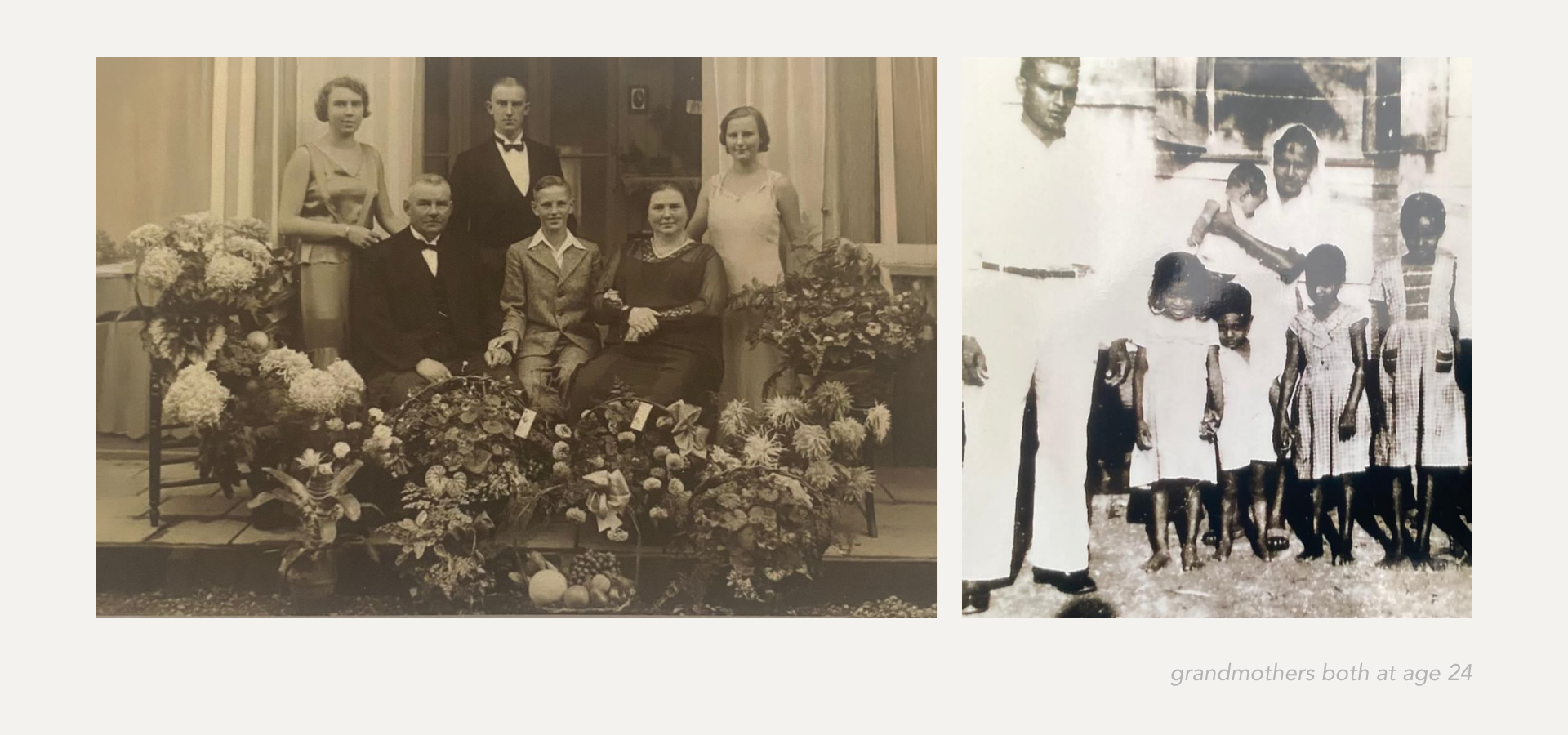
I think that fascination with contrast partly has its roots in the very different lives my grandmothers lived, and the unexpected similarities I recognized between them. By the age of twenty-four, my Hindustani grandmother already had five children. She lost her husband only a few years later, forcing her to face the challenges of life alone. My Dutch grandmother, at that same age, was still unmarried. At nineteen, in 1928, she had already obtained her driver’s license and was travelling across the world aboard a cruise ship, moving from country to country with a sense of freedom and independence that must have felt extraordinary for that time. Their lives could hardly have been more different, yet both carried an incredible strength.
Growing up with these two very different examples of womanhood shaped the way I look at identity. Their lives seemed worlds apart, yet I came to understand that difference does not exclude connection. It made me aware early on that contrasts can exist side by side. In many ways, these seemingly opposing worlds come together in me, continuing to shape how I think about identity and the layered nature of human experience.
Living Between Opposites
In many ways, contrast is just as much part of my personality as it is of my visual language. There is a side of me that longs for quietness and safety, while another side continuously searches for movement, experimentation and change. I like structure and control, yet some of the most meaningful moments in my work happen precisely when control disappears and something unexpected takes over.
For me, that tension feels inseparable from being an artist. You can intentionally work towards something an idea, but often the strongest images emerge through intuition or accident. Sometimes the work only truly begins once something stops going according to plan. I never want the process to become routine. The moment things feel too predictable, I instinctively start searching for a new tension or emotional contrast to explore.
Contrast as Visual Language
Those tensions also shape the images themselves. Photography introduced me early on to the power of black and white, and contrast still forms the foundation of how I build compositions. Opposites like light and shadow, organic forms against stronger geometric structures continuously interact within the work.
Many of the images balance between movement and stillness. Even the presentation reflects that duality: the image may feel fluid and open, yet it is still held within the boundaries of a frame.
For me, these contrasts are never purely aesthetic. They reflect emotional states that often exist beneath the surface. People can appear joyful while privately carrying sadness. Someone can feel fragile and powerful simultaneously. Human emotion is rarely one-dimensional, and I want the work to leave space for those layered experiences.
Fragmentation and Interpretation
My work often begins with photography, which I never experienced as something entirely objective or fixed. Through layering and abstraction, I gradually move the image away from direct representation and closer toward something more intuitive and psychological. I am interested in the idea that identity cannot be captured from one single perspective. I want multiple emotional realities to exist at once. That tension between structure and ambiguity not only exists within the image itself, but also within the process of making it.
Between Control and Surrender
I work with my own photography, sketches and textures, combining digital and physical techniques in layered compositions that slowly evolve. AI occasionally becomes part of that process, but not as the central focus. What interests me is not perfection or technology itself, but the unpredictability it can introduce. Sometimes unexpected distortions or accidents force me to respond differently, creating new directions I could not have fully planned beforehand.
Recently, I have also been working more with physical materials such as glass and stone. These materials resist control in their own way. They demand patience and acceptance. You cannot completely dominate them, and that uncertainty has become an important part of the work itself.
In the end, I think my practice continuously returns to the same realization: contrast and opposites strengthen each other. In a world increasingly shaped by polarization, my work explores how contrasts can coexist, creating space for multiple perspectives and deeper ways of understanding.